
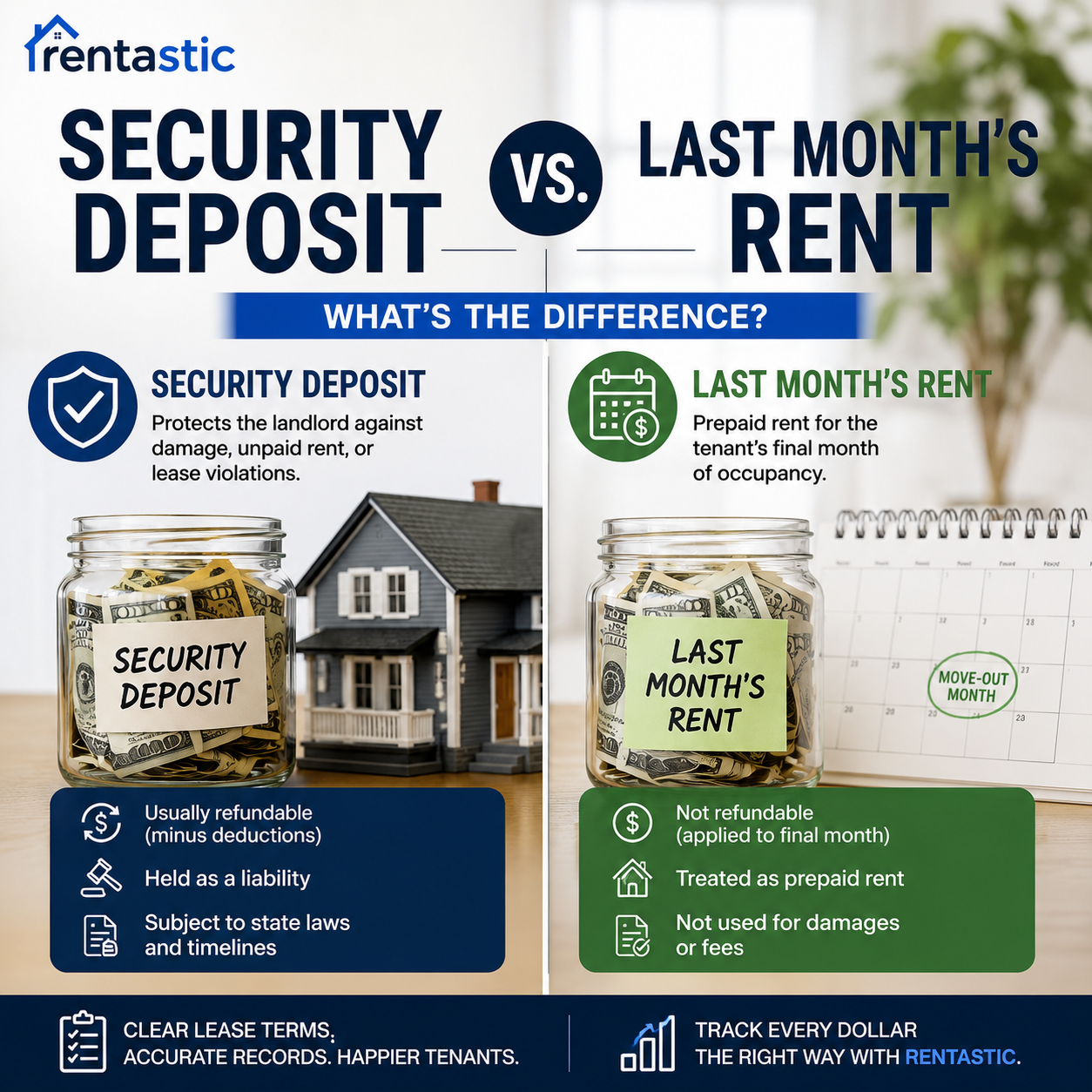
When a new tenant signs a lease, landlords often collect several upfront payments before move-in. Two of the most common are the security deposit and last month's rent.
While these payments may seem similar, they serve very different purposes, are treated differently under the law, and should be tracked separately in your accounting records.
Understanding the difference between a security deposit and last month's rent can help landlords avoid bookkeeping mistakes, remain compliant with local regulations, and prevent tenant disputes.
In this guide, we'll break down exactly what each payment is, how they differ, and how Rentastic helps landlords properly track them.
A security deposit is money collected from a tenant to protect the landlord against potential financial losses during the tenancy.
The deposit is generally refundable if the tenant:
Landlords may be able to use a security deposit to cover:
The primary purpose of a security deposit is protection.
Last month's rent is exactly what it sounds like: rent collected in advance that will be applied to the tenant's final month of occupancy.
Unlike a security deposit, last month's rent is not intended to cover damages or lease violations.
Its purpose is to ensure the landlord receives rent for the tenant's final month, even if the tenant's financial situation changes before moving out.
The primary purpose of last month's rent is prepaid rent.
Although both payments are collected upfront, they serve completely different functions.
Understanding these distinctions is critical for both legal compliance and accurate bookkeeping.
One of the biggest landlord mistakes is assuming these payments are treated the same under the law.
In many states, security deposits are heavily regulated.
Landlords may be required to:
Last month's rent may not be subject to the same rules because it is considered prepaid rent rather than a deposit.
However, laws vary significantly by state and municipality. Landlords should always verify local regulations before collecting either payment.
Consider the following example:
A tenant pays:
Six months later, the tenant causes $1,200 in property damage.
The landlord generally cannot use last month's rent to pay for repairs because that money is already designated for the tenant's final month of occupancy.
Instead, repair expenses may be deducted from the security deposit if permitted by law and properly documented.
This illustrates why each payment serves a distinct purpose.
From an accounting perspective, security deposits are generally considered liabilities.
Why?
Because the money may need to be returned to the tenant at the end of the lease.
When a landlord receives a security deposit:
The funds remain a liability until:
This is an important concept in rental property accounting because deposits are not immediately recognized as income.
Last month's rent follows a different accounting path.
When received, it is generally recorded as prepaid rent because the rental period it covers has not yet occurred.
When the tenant occupies the final month:
Because it eventually becomes rental income, last month's rent is treated differently from a security deposit.
Many landlords accidentally create accounting problems by failing to separate these payments.
This can inflate revenue and create inaccurate financial reports.
Mixing the two makes tracking difficult and can create confusion when tenants move out.
Without clear lease language, disputes may arise regarding how funds can be used.
For investors managing multiple units, property-specific tracking is essential.
Security deposit laws often include strict timelines for returning funds.
A well-written lease can prevent misunderstandings before they occur.
Your lease agreement should clearly identify:
Include:
Include:
Clear documentation protects both landlords and tenants.
To maintain accurate records, landlords should save:
Organized documentation is one of the strongest protections landlords have during disputes.
Managing rental deposits manually can become challenging, especially as a portfolio grows.
Rentastic helps landlords maintain accurate records by allowing them to:
Instead of relying on spreadsheets and manual calculations, landlords can keep all property finances organized in one place.
This makes it easier to understand exactly where money came from, how it should be categorized, and how each property is performing.
Continue learning about rental property bookkeeping and management:
These resources can help landlords improve record keeping and avoid costly accounting mistakes.
The debate over security deposit vs last month's rent often comes down to understanding purpose.
A security deposit protects landlords from damages, unpaid obligations, and lease violations. Last month's rent is simply prepaid rent reserved for the tenant's final month of occupancy.
Although both payments are commonly collected at move-in, they differ in their legal treatment, accounting classification, and intended use.
By keeping these payments separate, documenting them clearly in lease agreements, and maintaining accurate financial records, landlords can reduce disputes, improve compliance, and make rental property accounting significantly easier.
Whether you manage one property or an entire portfolio, properly tracking rental deposits and landlord rental fees is an important part of protecting your investment and operating a successful rental business.
RECENT POSTS


© 2025 Rentastic
Rentastic is registered as a trademark. Terms and conditions, features, support, pricing, and service options subject to change without notice.

















.png)
































.png)































Comments