

Tax season hits differently when you own rentals. You are not just filing a return, you are juggling IRS rules, local lodging taxes, depreciation, and a stack of receipts. If you own both short term and long term rentals, the details can get confusing fast.
This guide walks you through how short term vs long term rental taxes work as of 2025, how they show up on your return, and how tools like Rentastic help you stay organized so tax season feels a lot less stressful.
Before you decide how to report income, you need to know how the IRS views each type of rental.
Short term rentals are properties you rent for brief stays, usually under 30 days at a time. Think Airbnb, VRBO, or a furnished unit that turns over weekly. For federal tax purposes starting in 2025, the IRS treats many short term rentals more like hotels than traditional residential leases. That affects how you report income, how you depreciate the property, and in some cases whether the income is passive or active.
Long term rentals are properties you lease out for 30 days or more, typically on a standard lease. These are classic residential rentals and the IRS largely treats them as passive rental activities.
Both types generate taxable income. The big differences show up in:
If you get these categories right early in the year, tax season turns into simple data entry instead of detective work.
All rental income is taxable unless you fit into a narrow exception. During tax season you report the money you received, then subtract eligible expenses and depreciation. What is left is taxable income.
For 2025, rental income is taxed as ordinary income. That means it flows into your federal tax bracket, which ranges from 10% up to 37%, depending on your total income. This is true for both short term and long term rentals.
Any money you receive from tenants or guests is generally taxable rental income, including:
You usually report this income and related expenses on Schedule E of Form 1040. Accurate record keeping and proper use of Schedule E are crucial to stay compliant and to capture every deduction you are entitled to during tax season.
Where things start to diverge is how the IRS treats very short rental periods and certain short term rentals that look more like a business than a passive investment.
If you only rent your property a few days a year, the IRS gives you a rare and generous break.
This is the 14 day rule, sometimes called the Masters exception. If you rent out a dwelling unit for fewer than 15 days in the year, your short term rental income is not taxable on your federal return. You do not report that rental income at all and you do not pay federal income tax on it.
There is a tradeoff. If you use this exception you also cannot claim any rental expenses or depreciation related to that property for those days. You treat the property as a personal residence for federal income tax purposes.
There is an important catch. Even if your rental income is exempt from federal income tax under the 14 day rule, local lodging taxes can still apply. The IRS exemption does not cancel your responsibility to pay local hotel or Transient Occupancy Taxes on those nights.
So if you host a big event weekend for 10 days and make a solid profit, you might not owe federal income tax on that income, but you may still need to register with your city or county, collect lodging tax from guests, and remit those taxes on a monthly or quarterly schedule.
Once you rent for 15 days or more in a year, the exception disappears. All your rental income becomes taxable and different reporting rules kick in.
Once your short term rental crosses that 14 day threshold in a year, all your rental income must be reported to the IRS. As of 2025, enforcement is tighter, and hosting platforms like Airbnb or VRBO often issue Form 1099 K when you hit certain thresholds.
You are required to report your gross rental income whether or not you receive a tax form. That includes:
You need to aggregate everything into one total for the year. Tools like Rentastic help by pulling in transactions directly from your connected bank accounts so you can see your full income picture without digging through statements.
If you do not file a W 9 with the platforms you use, they may automatically withhold 28% of your rental payouts for taxes. This backup withholding is often higher than your actual tax liability. Completing a W 9 before the year gets rolling helps you keep more cash during the year and avoids surprise reductions in your payouts.
Short term rentals also interact with self employment tax in specific ways. The distinction between passive and active income matters. When you provide substantial services to guests, such as daily cleaning or concierge services, some or all of that income may be treated as active business income. Active income can be subject to self employment tax in addition to income tax, which increases your total tax bill. Understanding this line is one area where a tax professional who focuses on rentals can be very valuable.
Depreciation is one of your biggest tools for reducing taxable rental income during each tax season. You are allowed to deduct the cost of the property and improvements over time rather than all at once.
For long term residential rentals, the IRS generally lets you depreciate the building over 27.5 years. That works out to an annual depreciation rate of about 3.636%. If you own a $275,000 residential rental, you might see an annual depreciation deduction close to $10,000. This can significantly lower your taxable rental income year after year.
Short term rental properties often use a different depreciation schedule. Many are classified more like nonresidential real property, which has a depreciation period of 39 years. That spreads the same property cost over a longer period, which means smaller annual deductions. For a $390,000 short term rental property on a 39 year schedule, your regular annual depreciation deduction would be about $10,000.
You can also explore accelerated depreciation strategies, such as cost segregation studies. These studies break your property into components with shorter useful lives, which can front load more depreciation into the early years of ownership. That increases deductions in the near term and can boost early cash flow. These techniques must follow IRS rules closely, so this is another area where specialized tax advice is worth the cost.
Rentastic helps you keep depreciation straight by maintaining depreciation schedules and reflecting them in your Profit and Loss reports. Instead of manually tracking building basis and annual write offs in a spreadsheet, you can see your depreciation impact as part of your regular financial view.
Federal and state income taxes are only part of the picture for short term rental hosts. Local lodging taxes sit in their own category and behave differently.
Cities and counties often impose Transient Occupancy Taxes, hotel taxes, or similar charges on short term stays. These taxes are typically:
You are usually required to:
Hosting platforms sometimes collect and remit certain local lodging taxes on your behalf. However, coverage varies by jurisdiction and by tax type. You remain responsible for any local taxes that are not handled by the platform and for any filing requirements that still apply even when a platform remits payments.
Because of stricter enforcement starting in 2025, it is smart to set up a simple process early in the year. That process might include verifying which taxes Airbnb or VRBO collect in your city, registering for any remaining taxes yourself, and using a bookkeeping tool to tag those transactions correctly. Coordinating your local tax data with Rentastic helps you keep lodging tax outflows clear and separate from regular operating expenses.
Both short term and long term rental owners can reduce taxable income with proper deductions. During tax season, you subtract legitimate rental expenses from your gross income to get to net income for tax purposes.
Common deductible expenses include:
Depreciation sits alongside these operating expenses as a separate deduction. By spreading property cost and capital improvements over 27.5 or 39 years, you create a predictable annual tax shield.
To make the most of these deductions, you need:
Properly categorizing and understanding deductions can significantly reduce your overall tax liability. This is where a system like Rentastic shows its value. By connecting your bank accounts and credit cards, Rentastic automatically tracks rental income and expenses and helps you categorize them correctly. That cuts down on missed deductions and sloppy records, which are two common reasons landlords overpay tax.
Accurate and organized records are the foundation of smooth filings. That is true whether you own a single long term rental or a portfolio of short term properties across several cities.
Strong records help you:
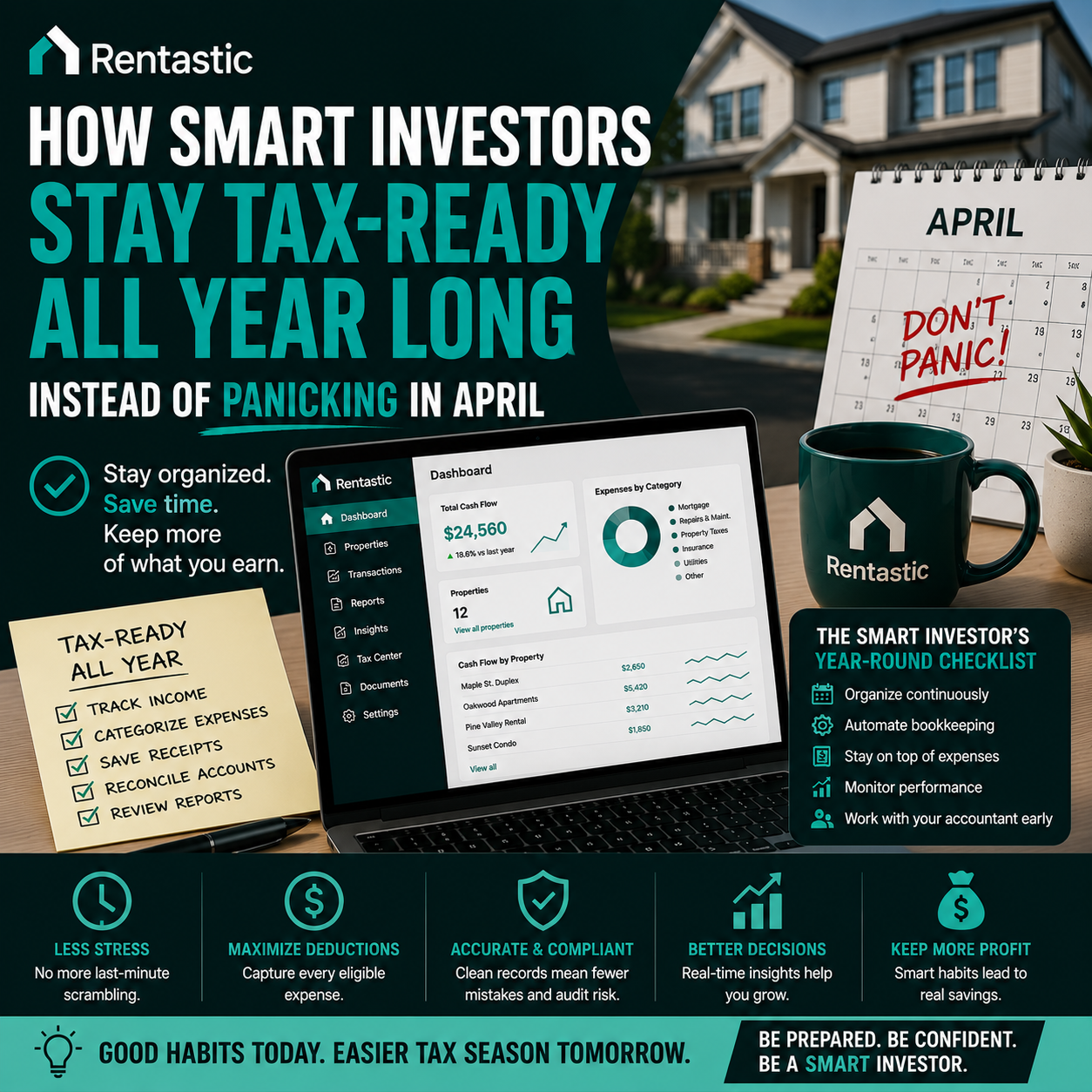
During tax season, the difference between a two hour session and a two week scramble is usually how disciplined your record keeping has been over the prior 12 months. Tracking every dollar of rental income and every expense throughout the year is crucial for a less stressful filing period.
Rentastic automates much of this work. Once you connect your financial accounts, it pulls in transactions, lets you assign categories, and generates on demand Profit and Loss statements. Many users report that what used to take days now takes seconds because the system is constantly keeping things up to date instead of you trying to rebuild a year of activity in March.
If you own both short term and long term rentals, the complexity multiplies quickly. Different depreciation schedules. Different local lodging tax rules. Mixed passive and active income. On top of all that, you still just want a clean P and L to hand your tax preparer.
Rentastic is designed to remove the friction you feel every tax season:
The visual data tools inside Rentastic turn your raw transactions into charts and graphs. You can see trends in rental income, watch expense categories over time, and spot where your cash is really going. That insight helps you make better financial decisions long before tax season arrives.
Many landlords who use Rentastic report less tax related stress and fewer errors. Automated data entry and better organization helps you avoid duplicate entries, missing income, or forgot to log that big repair last spring mistakes.
There is a lot you can do with good software and careful habits, but some situations really benefit from expert help. You should think about calling a tax professional who specializes in rentals if:
A rental focused tax pro can help you navigate complex rules, uncover deductions you might have missed, and ensure error free filings. That combination usually improves your tax savings enough to more than cover their fee.
Pairing that expertise with detailed, well organized data from Rentastic is a powerful combination. Instead of spending hours cleaning up your books, your CPA can spend their time on higher value tasks like tax planning and strategy.
Short term and long term rentals play by many of the same tax rules, but the differences matter. Short term rentals bring the 14 day rule, hotel style lodging taxes, and sometimes self employment tax into the picture. Long term rentals rely more on the classic 27.5 year depreciation and steady passive income.
If you focus on three habits throughout the year, tax season gets much easier:
You work hard to make your rentals profitable. A bit of upfront structure with your tax process helps you keep more of what you earn and walk into every filing season with a lot more confidence.
RECENT POSTS


© 2025 Rentastic
Rentastic is registered as a trademark. Terms and conditions, features, support, pricing, and service options subject to change without notice.



.png)






















.png)

































Comments