

Nearly every Airbnb host wonders the same thing at tax season:
“Can I really deduct all these cleaning fees and supplies?”
You can usually write off much more than you think. The key is knowing what the IRS treats as a legitimate business expense, how your short term rental is classified, and how to keep simple but solid records.
You will see the term “short term rental” a lot here. The rules below apply whether you list on Airbnb, Vrbo, or any other platform.
Before you decide what you can deduct, you need to know how the IRS looks at your place. That starts with two questions: how many days you rent and what kind of services you offer.
If you only rent your property occasionally, the 14 day rule might apply.
then that rental income is completely tax free and does not need to be reported, according to Rentastic’s summary of IRS rules for 2025. You also cannot deduct any rental expenses in that scenario, including cleaning fees and supplies.
Once you cross into 15 days or more, everything changes. The IRS expects you to report all rental income and follow full short term rental tax rules for tax season. At that point, cleaning and supplies move into the “potentially deductible” column.
If you rent 15 days or more, the next question is how your income is classified.
Most short term rentals land on Schedule E of Form 1040 as passive rental income. This is typically the case when you offer minimal services, for example:
In that case, your income is usually not subject to self employment tax.
If you provide substantial services, the IRS may treat you more like a hotel or B&B. That often means reporting your income on Schedule C as active business income, which is subject to self employment tax of about 15.3 percent. Substantial services might include:
The IRS draws a line between simply preparing the space for the next guest and running a full service operation. That distinction matters for tax season, but in both cases, cleaning fees and supplies tied to your rental are generally deductible business expenses. The category (Schedule E or C) mostly affects which form you use and whether self employment tax kicks in, as highlighted in Rentastic’s 2025 guidance.
Cleaning is central to the guest experience, and the IRS recognizes it as a normal cost of doing business for rentals.
If you pay a cleaning company or an individual cleaner to get your place ready before or after guests, those fees are typically deductible.
That includes:
You will usually report these as cleaning and maintenance expenses on your rental schedule. Since the IRS requires you to report all gross rental income, not just what hits your bank account after fees, you want to capture these outflows too so your taxable income reflects your real profit.
Platforms like Airbnb may report your earnings on Form 1099 K, but they do not track your expenses. Rentastic notes that the IRS expects you to keep meticulous records of all income and expenses regardless of whether you get a tax form from the platform. That includes the amounts you pay cleaners.
Many hosts add a separate cleaning fee line item to each booking. You might wonder if that helps your tax picture.
Here is how it usually works:
You do not avoid income tax on that fee just by labeling it “cleaning.” What makes the difference is matching that extra income with the real cleaning costs you incur.
Your goal for tax season is to:
If the numbers are close, the cleaning fee income and cleaning expense will largely offset each other in your tax calculation, which reflects what is actually happening in your business.
If you use the property yourself as a vacation home and then pay for a cleaning, you have to be more careful.
Cleaning that is tied to your personal use is personal, not rental, and generally is not deductible. If you mix personal and guest stays, you usually need to allocate your expenses between rental and personal days.
A common approach is to:
The IRS rules here can get technical. Rentastic recommends working with a tax professional for complex mixed use situations, especially once your property becomes a significant part of your portfolio.
Cleaning supplies might not feel like a big line item, but they add up over a year of short term rental bookings. The good news is that many of them are ordinary and necessary expenses that are deductible.
Supplies that are used to clean and maintain the rental for guests are typically deductible. For example:
The key is that the products are used for the rental activity, not just for your own home. If you buy in bulk and share supplies between your personal residence and the Airbnb, be ready to reasonably allocate how much belongs to each.
You can usually deduct smaller tools and equipment used for cleaning, such as:
For larger equipment like a high end vacuum or steam cleaner, the treatment might depend on cost and your accountant’s approach. Some items may qualify as supplies, others may be treated as depreciable assets that are written off over several years. A tax pro can help you apply these rules correctly during tax season.
Some supplies are both guest amenities and cleaning helpers. For example:
These are usually treated as deductible operating expenses. They are necessary to keep the rental functional and hygienic for guests, which is exactly what the IRS expects from a short term rental operation.
Cleaning and supplies do not live in isolation. They connect to a wider web of deductible costs that keep your place guest ready.
Expenses like water, electricity, and gas are generally deductible in proportion to your rental use, since they are necessary to run appliances that support cleaning and guest comfort. Frequent laundry loads, dishwashing, and vacuum use all rely on these.
You may also be able to deduct:
These fall into typical deductible expenses that Rentastic highlights for short term rental owners, alongside cleaning fees and maintenance.
Sometimes cleaning overlaps with repairs or improvements. For instance, you may:
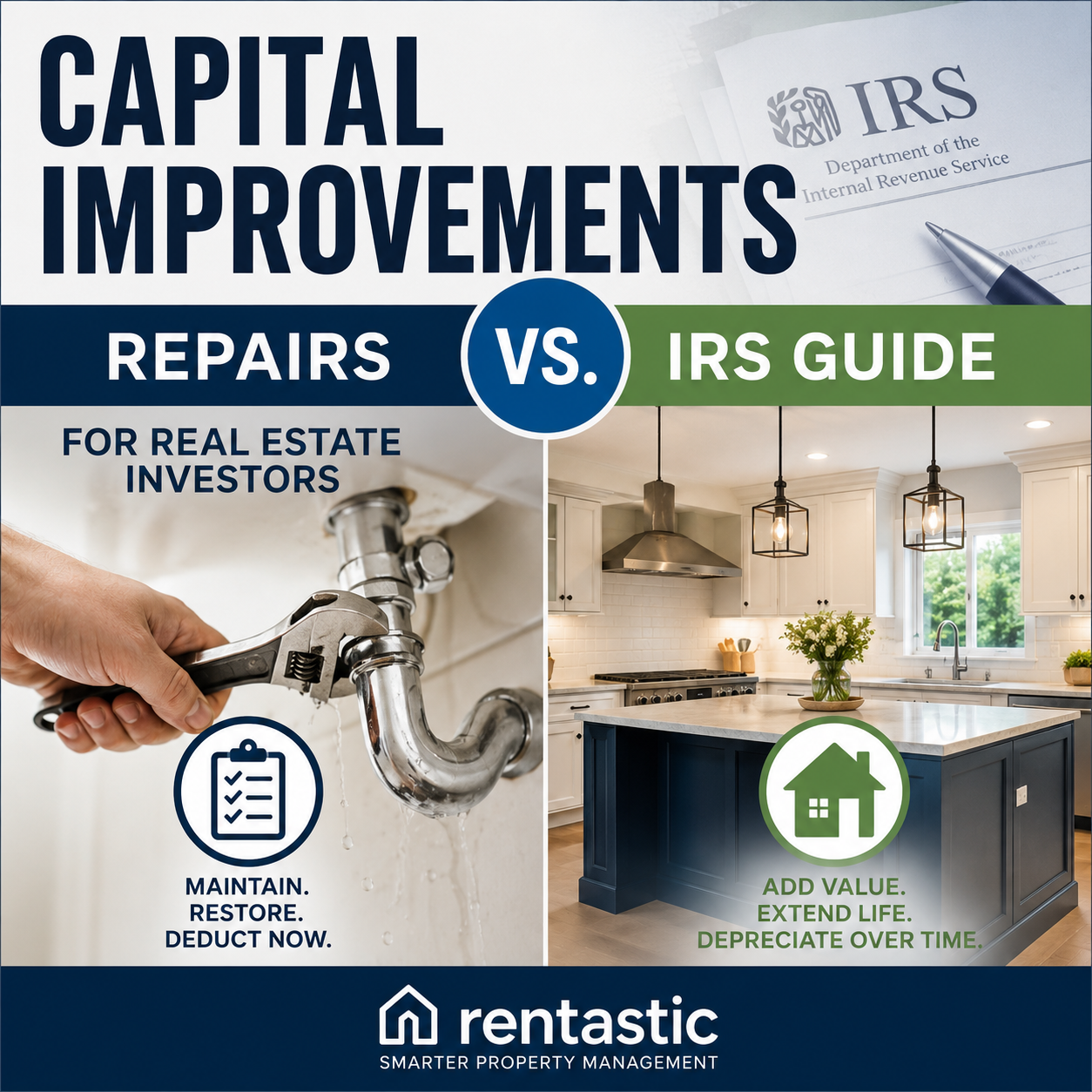
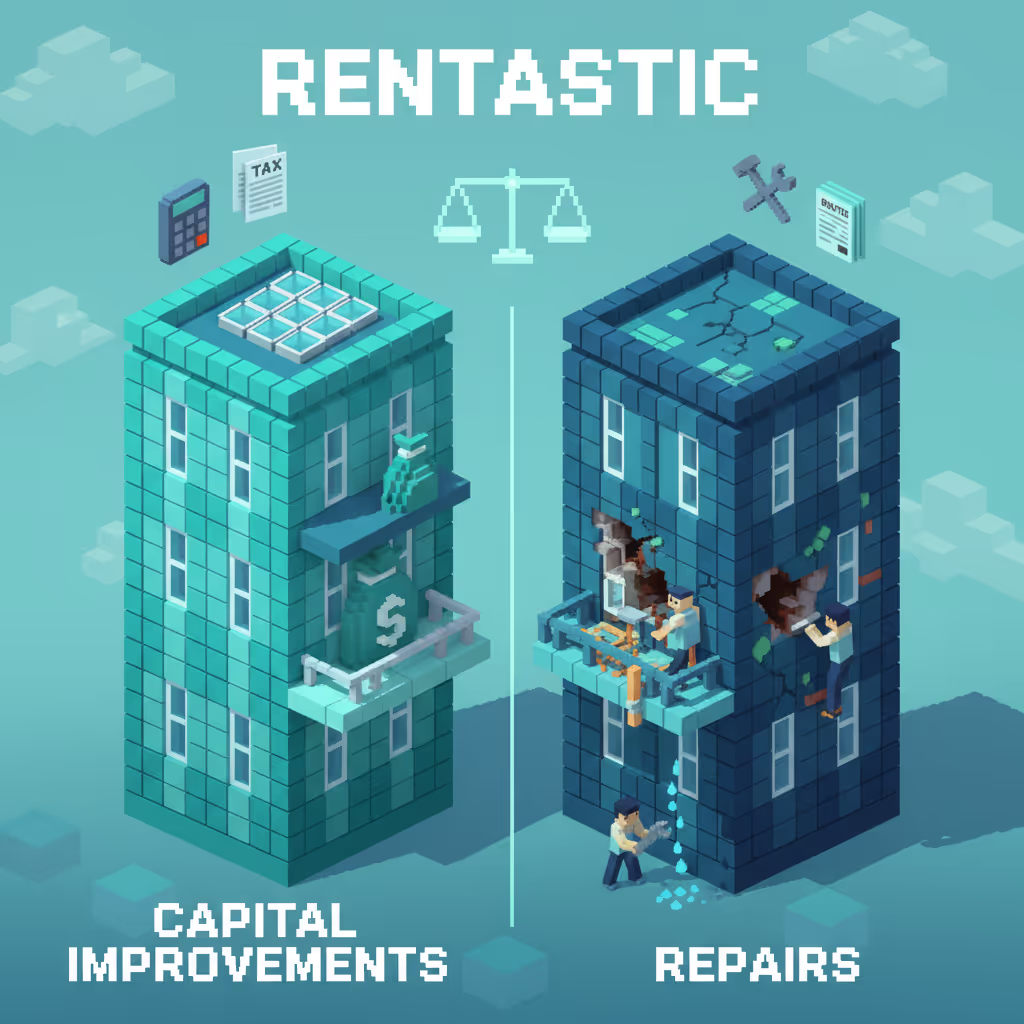
A simple fix, such as patching or repainting a small area, often counts as a repair and is deductible in the year you pay for it. Larger projects that improve or extend the life of the property, such as full bathroom remodels, are usually treated as capital improvements and deducted through depreciation instead.
Distinguishing valid repairs from improvements is important. Rentastic notes that short term rental owners can maximize deductions by applying depreciation rules correctly, especially as of the 2025 tax season, when bonus depreciation has been changing.
Cleaning keeps your property in good shape day to day. Depreciation covers the long term wear and tear that the IRS allows you to deduct over many years.
You cannot depreciate cleaning itself, but you can depreciate the building and many big ticket items that cleaning helps preserve.
Depreciation schedules differ depending on how your property is classified:
In either case, depreciation is separate from daily cleaning. You claim both: cleaning as a current expense, depreciation as a non cash expense that spreads the cost of the asset over time.
As of the 2025 tax year, bonus depreciation on qualifying capital purchases for short term rental properties was reduced to 40 percent from 60 percent in 2024. That makes timing more important if you are planning large upgrades like:
If you bunch these purchases before year end, you might claim more depreciation in the current tax season. If you delay, you might spread the deductions out further. Since the rules keep shifting, Rentastic strongly recommends professional advice around timing and classification of big improvements.
You only get the benefit of cleaning and supply deductions if you can show what you spent. That does not require complicated spreadsheets, but it does require consistency.
For tax purposes, you want a clear trail that shows:
That might be screenshots of invoices, bank or credit card statements, or line items from your cleaning app. The IRS expects you to report gross rental income from all short term rental bookings, so it is smart to be equally precise about your expenses.
Mixing personal and rental expenses in one account is where many hosts lose deductions or raise audit risk. A cleaner setup looks like this:
Once you split personal and rental spending at the bank level, tracking cleaning supplies and services becomes much easier at tax season.
Manually tracking dozens or hundreds of cleaning line items is where hosts get overwhelmed. This is exactly the problem tools like Rentastic are built to solve.
According to Rentastic’s 2025 product information, the platform can:
That automation lets you focus on running your short term rentals, while the data you need for tax season stays organized in the background.
Cleaning and supplies are only part of your tax picture. The schedule you file, your level of services, and your planning around estimated payments all interact with those deductions.
If your short term rental is reported on Schedule C because you provide substantial services, your net income is typically subject to self employment tax at roughly 15.3 percent. The upside is that you may have broader expense deduction options and you are treated more like an active business.
If you report on Schedule E, you usually avoid self employment tax, but your income is treated as passive. Either way, cleaning and supplies remain deductible, but your total tax rate on that net income will differ.
Year end is a good time to review what services you actually provided and confirm which classification applies before you file for this tax season. The IRS looks at what you did during the year, not just what you planned.
Short term rental income that is not subject to withholding can lead to an unpleasant surprise in April if you do not plan ahead. Rentastic points out that landlords expecting to owe more than $1,000 in taxes for 2025 should consider making quarterly estimated payments to avoid underpayment penalties.
You can use your year end Profit and Loss reports, including all those cleaning and supply deductions, to estimate your net rental income and your tax liability. That helps you:
You do not need to become a tax expert to get the benefit of cleaning and supply write offs. You just need a repeatable system.
Here is a practical flow you can use:
When you follow these steps, the answer to “Can you deduct Airbnb cleaning fees and supplies?” becomes clear. In most cases you can, and those small recurring costs add up to meaningful savings at tax season, especially when you track them accurately and pair them with smart tax planning.
RECENT POSTS


© 2025 Rentastic
Rentastic is registered as a trademark. Terms and conditions, features, support, pricing, and service options subject to change without notice.





.png)


























.png)


































Comments