

Monthly reconciliation is one of those unglamorous habits in real estate investing that quietly protects your profits. When you compare your bank and credit card statements to your accounting records every month, you catch missing rent, duplicate charges, and miscategorized expenses before they snowball. For landlords and property managers, this is the difference between feeling on top of your portfolio and dreading tax season year after year.
In this guide, you will walk through a simple, repeatable monthly reconciliation checklist that scales from a single duplex to a 200 door portfolio. You will see how automation tools like Rentastic can cut your workload in half while giving you cleaner books and more confidence with every decision you make in real estate investing.
Monthly reconciliation is the process of comparing each line on your bank and credit card statements with your accounting records, then fixing any mismatches. For real estate investors, this means checking that every rent payment, mortgage, utility bill, and contractor invoice is correctly recorded for every property.
According to Rentastic, real estate reconciliation is essential if you want accurate financial reporting, stronger protection at tax time, and better investment decisions across your portfolio (Rentastic.io Blog). In practice, this is not about becoming an accountant. It is about making sure the money you think you have actually matches the money in your accounts.
If you are used to spreadsheets and paper receipts, reconciliation probably feels slow and manual. Nearly half of landlords spend hours each month chasing receipts and reconciling statements, often missing deductions and making mistakes that eat into profits (Rentastic). A simple checklist and the right tools fix most of that pain.
The first decision is when and how often you will reconcile. For most rental portfolios, monthly is the sweet spot. It is frequent enough to catch issues quickly without turning bookkeeping into a daily chore.
Pick a recurring date that fits your cash flow pattern. Many investors choose a day between the 10th and 15th of each month so that most rent payments and common bills have cleared. Block 60 to 90 minutes on your calendar. If you reconcile multiple entities or properties, you might split it into two shorter sessions.
You also want a clear owner. If you have a bookkeeper, property manager, or CPA, decide who leads reconciliation and who reviews the final numbers. If you self manage, you are the one owning this process, even if software and an accountant support you behind the scenes.
Before you dive into the numbers, pull everything into one place so you are not hunting for logins or crumpled receipts mid session. At a minimum, you will want:
Rentastic recommends organizing financial documents and using accounting software to streamline bank reconciliation so you can manage your portfolio more efficiently (Rentastic). If you use a system like Rentastic that syncs bank accounts, much of this data will already be visible in one dashboard.
If you manage several properties, it helps to have a standardized chart of accounts so each transaction can be assigned quickly. A customized chart of accounts per property makes it easier to reconcile multiple income streams without mixing them up (Rentastic).
If you track your portfolio in a spreadsheet, you will download CSV files from each bank and card account and paste them into your tracker. If you use dedicated real estate investing software, you can usually link your accounts directly so new transactions appear automatically.
Rentastic users can link bank or escrow accounts and automate transaction entry, which cuts manual entry time by up to 40 percent and reduces errors in rental property bookkeeping (Rentastic). Automated bank syncing imports transaction data in real time and flags unmatched items so you spend more time reviewing and less time typing (Rentastic).
Once your feeds are up to date for the month, you are ready for line by line review. If any feed is missing days or looks incomplete, fix that before you go further so you are reconciling against a full set of data.
Clean categories are what turn raw transactions into meaningful reports. During reconciliation, you will assign or confirm a category for each line so that your income, expenses, assets, and liabilities reflect reality.
For rental property accounting, it is especially important to separate:
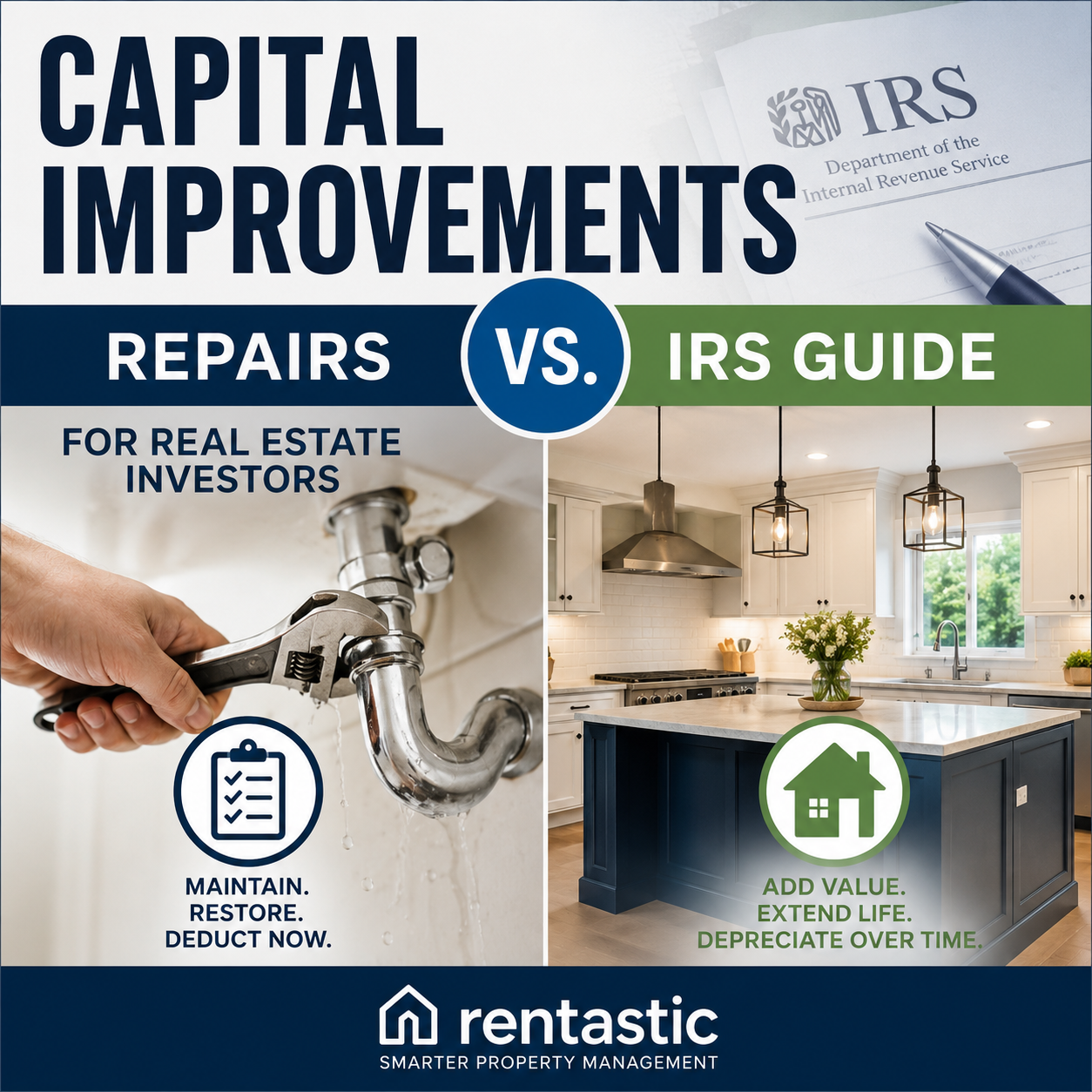
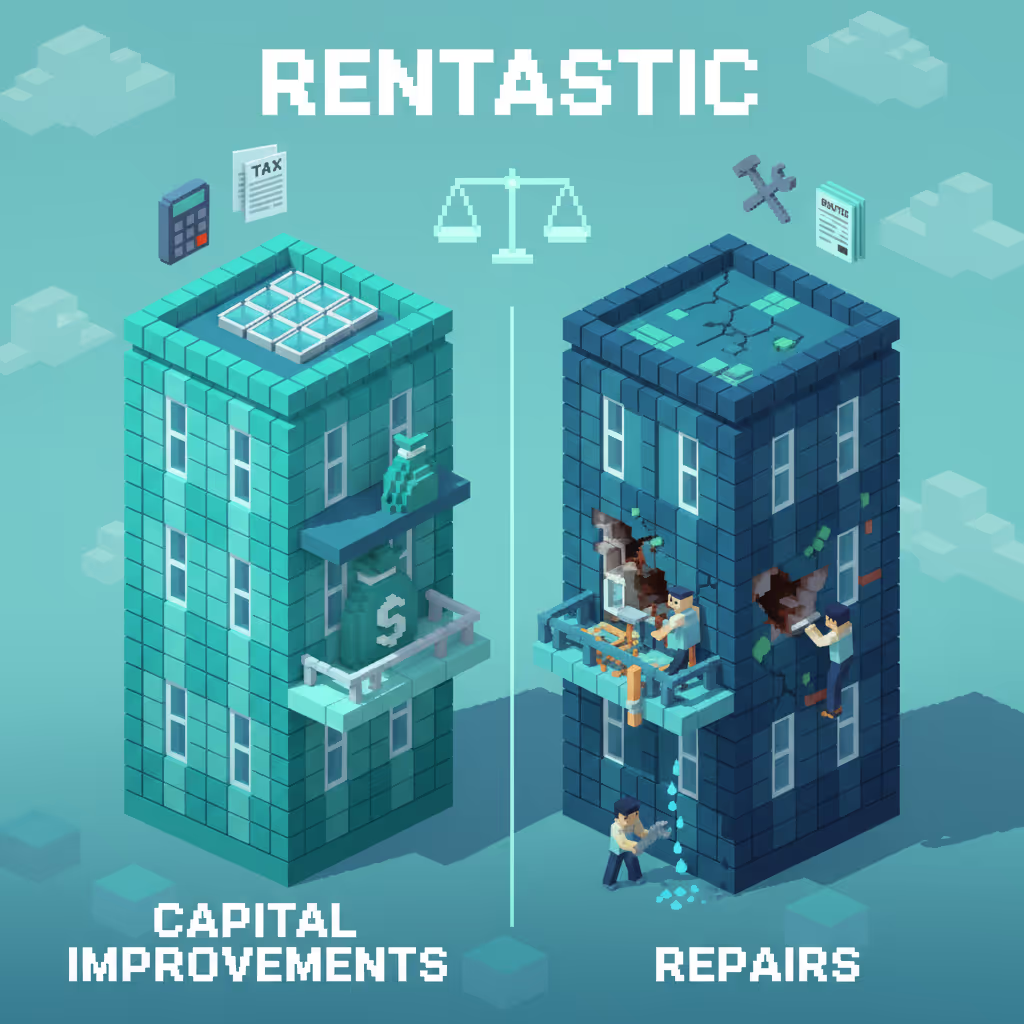
Rentastic notes that distinguishing operating expenses from capital improvements is critical for optimizing tax deductions and cash flow management, and that getting this wrong can cost you thousands over a property’s life (Rentastic). Inaccurate categorization is common, with 22 percent of landlords reporting they lost thousands in deductions because they misclassified repairs and improvements (Rentastic).
If you use Rentastic, its automated categorization engine can eliminate up to 70 percent of manual tagging, which speeds up bookkeeping and lets you generate real time reports with far less effort (Rentastic.io Blog). You still stay in control by reviewing edge cases, but the bulk of everyday items are handled for you.
This is the heart of reconciliation. You are checking that every transaction in your records matches something on your bank or card statement, and vice versa.
Work account by account, property by property:
Real estate specific reconciliation often reveals:
Rentastic’s reconciliation tools help users cut time spent on this step by up to 50 percent by flagging unmatched transactions and guiding you through the review (Rentastic). Automated bank reconciliation that is tightly linked to your accounting records also helps you identify mismatches quickly and maintain precise financial reports for cash flow and tax planning (Rentastic).
If you find discrepancies, investigate immediately. Sometimes it is just a typo or a timing difference. Other times, a mystery withdrawal or missing deposit might signal bank errors or fraud, which is exactly what regular reconciliation is meant to catch early (Rentastic).
Rent is the lifeblood of your portfolio, so your monthly checklist should dedicate special attention to income. You want to be sure that:
A best practice is to reconcile your rent roll against your bank deposits. For each tenant, you confirm the amount due, the amount paid, and the date it cleared. Any gaps become action items for collections or follow up.
Automated bank reconciliation and integrated online payments can reduce late rent payments by 25 percent, because you detect and act on payment issues faster when payment data flows directly into your accounting system (Rentastic). Nearly 80 percent of renters have the option to pay online but fewer than 10 percent do, so nudging tenants toward digital payments makes collection and reconciliation far smoother (Rentastic).
By the end of this step, you should have a clear list of tenants who owe money, plus a plan for reminders or late fee policies that align with local laws.
As your real estate investing grows, mixing transactions between properties or entities is one of the easiest ways to confuse yourself and your CPA. Monthly reconciliation is your chance to keep these lines clean.
You want to:
Rentastic highlights that a customized chart of accounts for each property helps handle the complexity of reconciling several income streams at once (Rentastic). When you keep each property’s numbers clean, you can see which assets are carrying their weight and which ones are draining your time and cash.
This also becomes critical if you refinance, sell, or complete a 1031 exchange, since lenders and tax professionals will expect clear, property level financials.
Reconciliation is not only about catching mistakes. It is also the moment when you step back and see where your money actually went this month. A simple way to do this is to generate a Money In / Money Out report.
Rentastic describes this report as a clear snapshot of every cash inflow and outflow, like rent payments and maintenance bills, so you can avoid surprises and adjust quickly (Rentastic). Once your month is reconciled, you can quickly spot:
This is also the right moment to check that you have enough liquidity for upcoming taxes, insurance renewals, or large capital projects you can see on the horizon.
After you finish categorizing and matching, you are ready to click into the reports that matter most for your portfolio. At a minimum, most investors rely on:
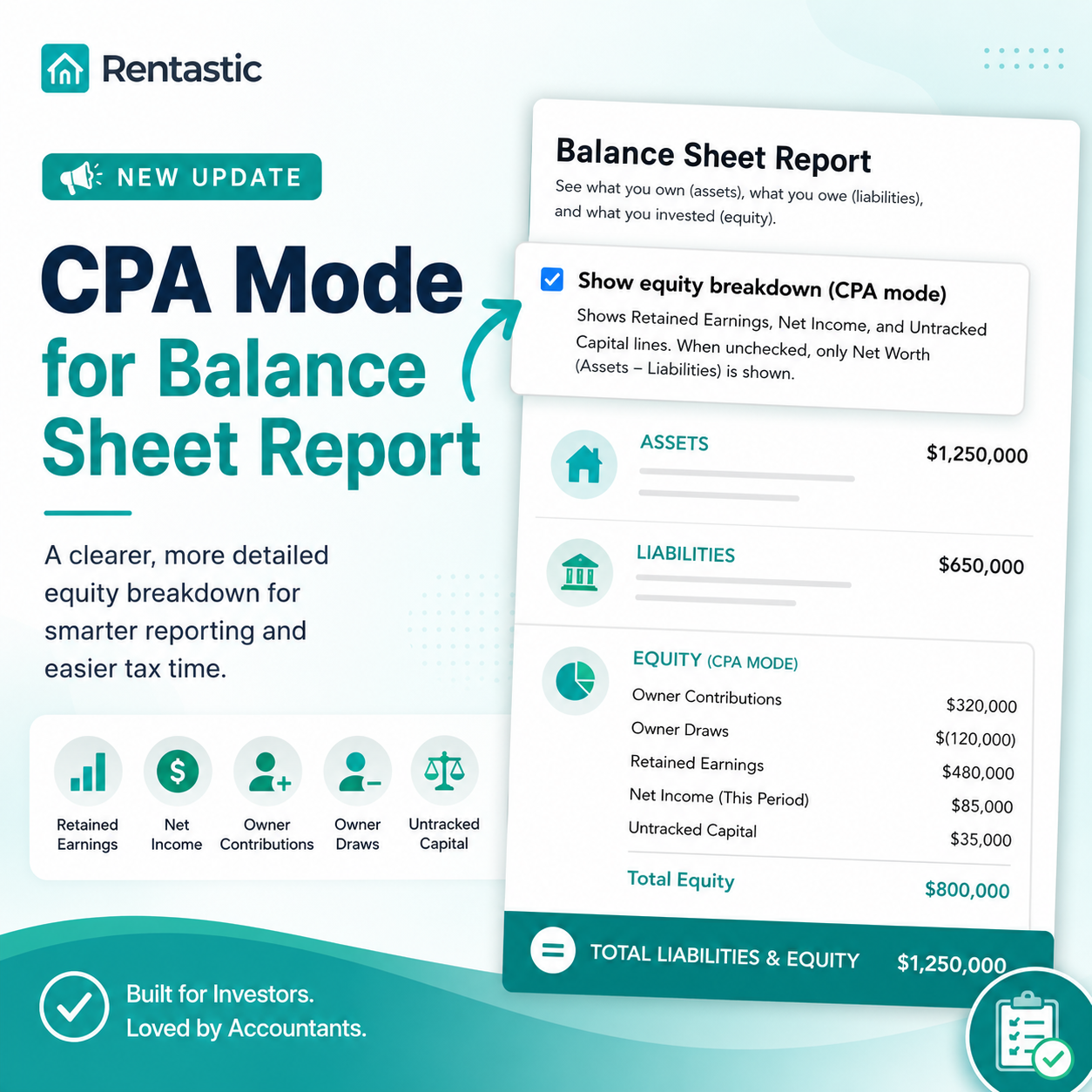
Rentastic notes that landlords who generate monthly P&L reports feel 25 percent more confident in their tax position because they know how revenue and expenses stack up each month (Rentastic). A well maintained balance sheet that shows what you own versus what you owe also reveals trends like rising debt or stagnant asset growth, and quarterly reviews help you stay lender ready (Rentastic).
If you are evaluating performance, you might also run an ROI or cash on cash analysis. Typical solid ROI benchmarks for rental properties fall between 8 percent and 12 percent, and including loan interest in your calculation gives you a more realistic view of performance (Rentastic).
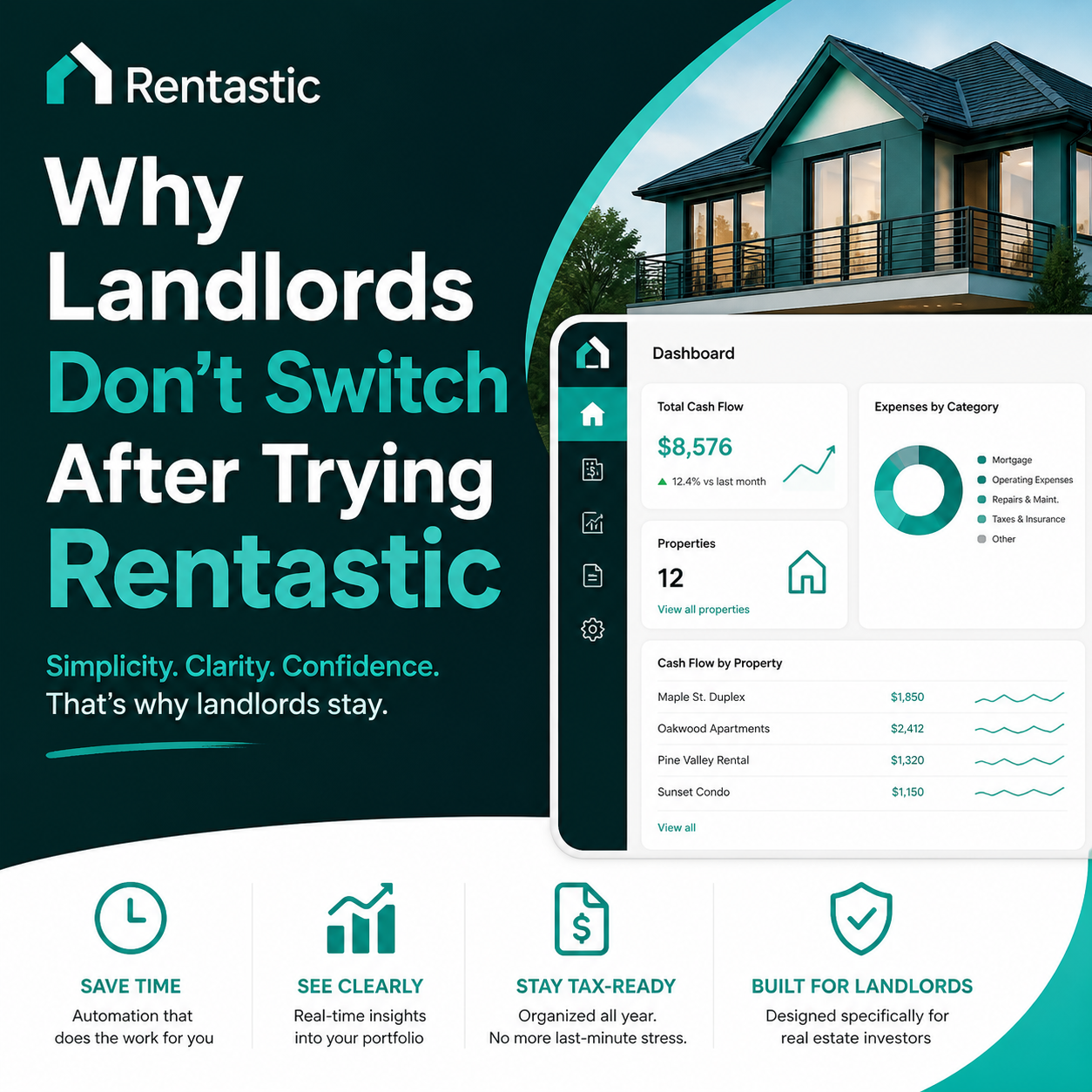
With tools like Rentastic, you can generate these reports for any date range or individual property at the click of a button, thanks to real time dashboards that consolidate income, expenses, and profitability across your portfolio (Rentastic Blog).
Once your books are reconciled, your reports stop being guesses and start becoming a reliable map for every decision you make.
Monthly reconciliation directly affects your tax bill. When your books are accurate, you do not wait until March or April to discover missing deductions or messy records that cost you money.
Rentastic’s research shows that landlords who maintain detailed expense categories and strong documentation through rental expense reconciliation avoid between 600 and 1,200 dollars in unclaimed tax deductions per year, which directly improves net cash flow without changing rents or service levels (Rentastic). Accurate, regular bank reconciliation also makes it easier to track deductible expenses and prepare for taxes, often reducing CPA fees because your records are cleaner (Rentastic).
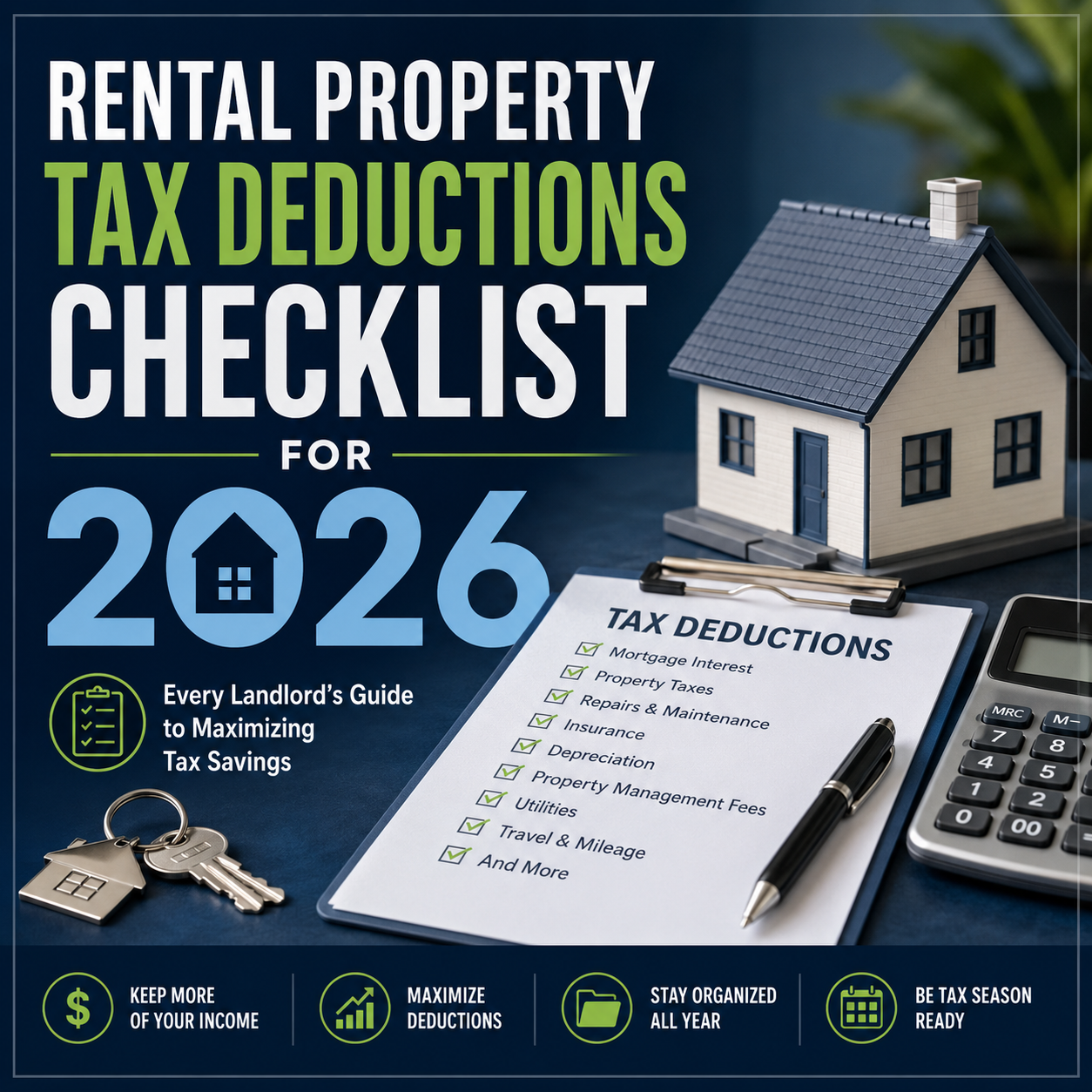
You can go one step further and use these reconciled numbers to drive strategy. Depreciation typically lets you deduct the cost of residential rentals over 27.5 years, so a 275,000 dollar property can yield about 10,000 dollars in yearly depreciation deductions (Rentastic Blog). Tax credits like the Low Income Housing Tax Credit provide dollar for dollar reductions in federal tax for certain projects, which can reshape how you evaluate deals (Rentastic Blog).
Real estate bookkeepers use reconciled data to help clients time improvements, plan 1031 exchanges, and maximize deductions, and they often lean on platforms like Rentastic to streamline both bookkeeping and tax reporting (Rentastic Blog).
You do not need to love bookkeeping to benefit from monthly reconciliation. You just need a system that turns several hours of manual work into a quick, predictable habit.
Purpose built tools like Rentastic are designed for rental property bookkeeping and can reduce manual data entry by up to 40 percent and cut reconciliation time by 50 percent, all compared to traditional spreadsheet methods (Rentastic Blog). When you link your bank accounts, you can eliminate up to 70 percent of manual transaction tagging with automated categorization rules, which lets you maintain up to date books in minutes instead of hours (Rentastic Blog).
Real estate investors who switch from spreadsheets to Rentastic often save over 1,000 dollars per month in labor costs at a 50 dollar hourly rate, and 79 percent rated it 5 out of 5 for ease of use and value for money in 2025 (Rentastic.io Blog). A 2024 study also found that landlords using automated tools that generate P&L statements from linked bank accounts spent 30 percent less time on accounting than those relying on spreadsheets (Rentastic).
If you are migrating from spreadsheets, Rentastic can import up to 24 months of past bank transactions and connect hundreds of financial institutions, which makes the shift to an automated platform smoother than starting from scratch (Rentastic Blog).
You now have a practical, scalable monthly reconciliation checklist for your rental portfolio:
You are not just “doing the books.” You are building the financial engine that supports every smart move you make in real estate investing. Start with your next month, block the time, and lean on automation where it makes sense. Each time you complete this checklist, your numbers will get cleaner, your decisions will get sharper, and your portfolio will feel easier to run.
RECENT POSTS


© 2025 Rentastic
Rentastic is registered as a trademark. Terms and conditions, features, support, pricing, and service options subject to change without notice.





.png)



























.png)




































Comments