

Owner statements can feel like a black box.
You see rent in, bills out, and a final number labeled “owner draw.” If that number is wrong, you may not catch it for months, and by then the damage is done. That is where owner statement reconciliation becomes one of the most important habits in your real estate investing playbook.
In simple terms, reconciliation means comparing what your property manager says happened with what actually hit your bank, credit card, and internal records. When you do it consistently, you protect your cash flow, avoid tax surprises, and keep investor relationships healthy.
Below, you will learn how to build a clear, repeatable reconciliation process that works whether you own one rental or manage a full portfolio.
If you are serious about real estate investing, reconciliation is not optional. It is how you verify that every dollar is going to the right place.
Rental expense reconciliation helps you:
Rentastic notes that landlords who stay organized with rental expense reconciliation avoid losing between 600 and 1,200 dollars per year in unclaimed tax deductions, which directly boosts your net cash flow without raising rents or cutting service quality (Rentastic).
As your portfolio grows, small errors compound. Regular bank reconciliation gives you precise reports at tax time, improves cash flow visibility, and reduces the risk of financial chaos later on (Rentastic.io Blog).
Reconciliation is not just bookkeeping. It is a strategic part of real estate investing because it tells you whether your properties are performing the way your pro forma predicted.
Without accurate, reconciled numbers you cannot answer basic questions:
Return on Investment (ROI) is a core metric in real estate investing. Rentastic highlights that solid ROI benchmarks often fall between 8 and 12 percent, and that you need to include financing costs like loan interest to get an accurate number (Rentastic). If your owner statements are not reconciled, those ROI calculations are guesswork.
You also need clean data to evaluate new deals. Rentastic’s deal analyzer uses purchase price, rehab costs, rent estimates, and financing terms to calculate expected returns and help you compare opportunities quickly (Rentastic Blog). Those projections only matter if you can later compare them to reconciled actuals.
Before you can reconcile, you need to know what a solid owner statement looks like. At a minimum, each statement should include:
Your goal is to trace the story of how cash moved from tenants to vendors and finally to you.
If your statements are missing key details, ask your property manager for more transparency. You want to see line items that match real transactions, not a single lump labeled “maintenance.”
Owner statement reconciliation starts with pulling everything into one place. For each property and statement period, you will want:
Nearly half of landlords spend hours each month chasing receipts and trying to reconcile statements by hand, often missing deductions or making errors that eat into profitability (Rentastic). Centralizing your documents is the first step to breaking that pattern.
If you use real estate accounting software, link your bank and card accounts so that deposits and expenses sync automatically. Rentastic reports that users can reduce manual entry time by up to 40 percent when they connect their accounts directly to the platform (Rentastic).
Start reconciliation with income. For each rent and fee entry on the owner statement, verify that:
According to the National Apartment Association, about 15 percent of renters miss at least one payment each year, which creates real losses for landlords who are not watching their ledgers closely (Rentastic).
If your property manager offers online payments tied to accounting software, take advantage of it. Rentastic notes that integrating online tenant payments with automated tracking can reduce late rent payments by 25 percent because you can spot issues faster and follow up quickly (Rentastic.io Blog).
When you reconcile income:
Any mismatch is a signal to dig deeper.
Next, move through every expense on the owner statement. Your main job is to confirm that:
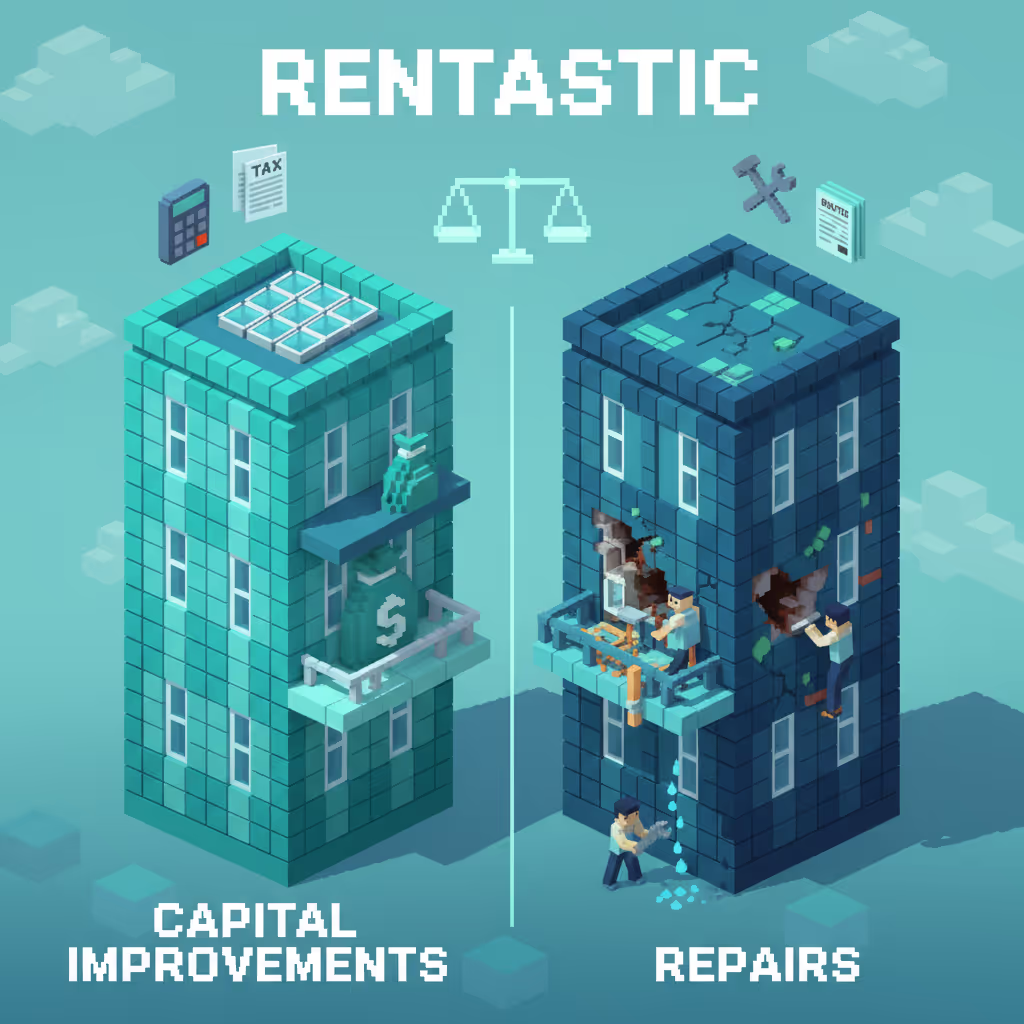
Distinguishing between operating expenses and capital expenses is critical. Rentastic points out that properly separating day to day costs like repairs and insurance from major improvements like a new roof can save you thousands of dollars over the life of each property through better tax treatment and cash flow planning (Rentastic).
In practice, this means:
A 2024 survey cited by Rentastic found that 22 percent of landlords lost thousands in tax deductions because they miscategorized repairs and improvements (Rentastic). Reconciliation time is your chance to catch and correct these mistakes while they are fresh.
You do not need to become a tax attorney, but you do need a clear, consistent rule set for how you and your property manager label expenses.
Management fees are usually straightforward, but they are still worth reconciling. Check:
If you keep reserves with your property manager, reconcile those movements too. You should see clear entries for “reserve contribution” and “reserve release” and they should match your understanding of how big the reserve should be.
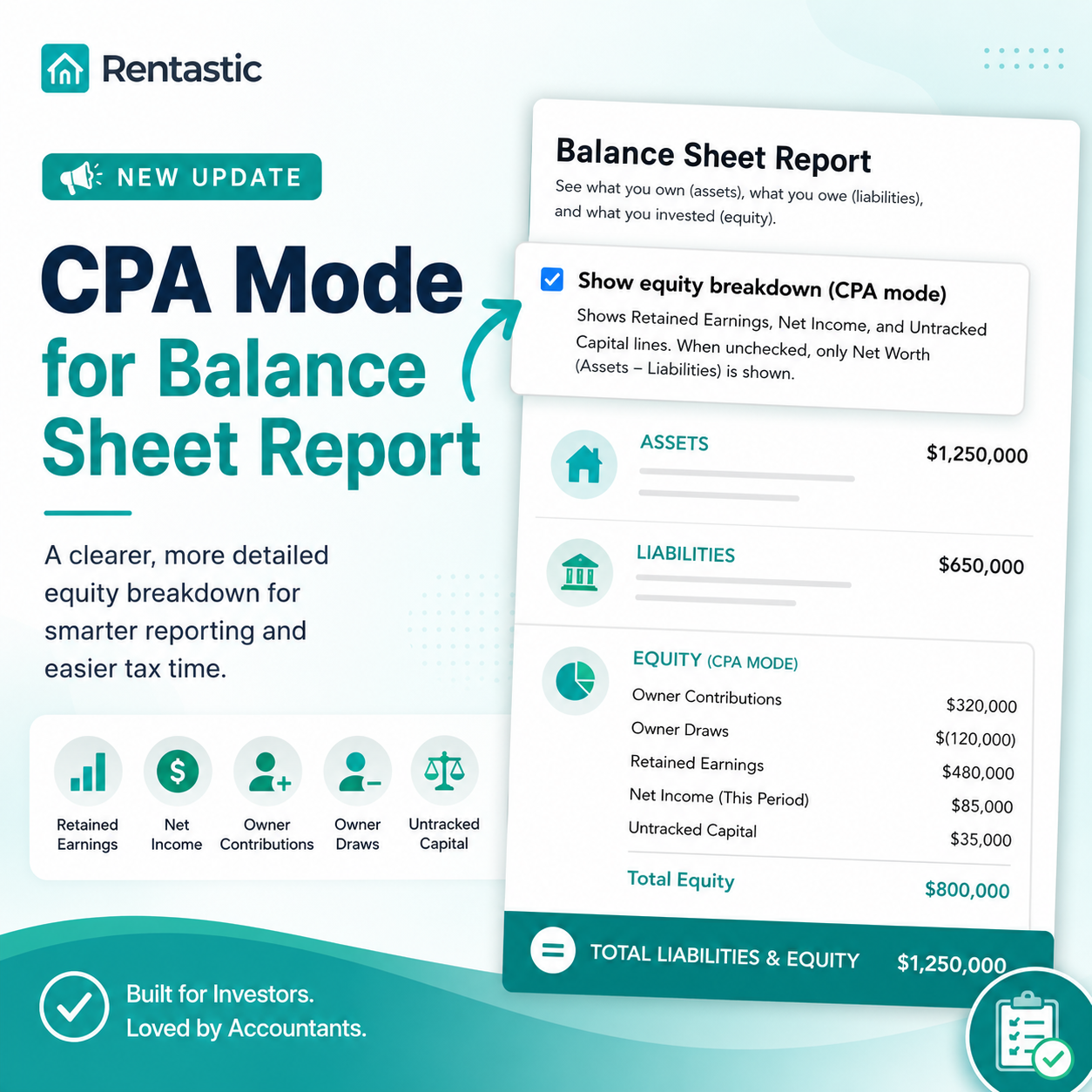
A well maintained balance sheet that includes reserve accounts gives you a snapshot of net worth and helps you spot issues like rising debt or stagnant asset growth. Rentastic recommends quarterly reviews for this reason (Rentastic).
Once you have checked income, expenses, fees, and reserves, it is time to zoom out. Your final reconciliation step is to tie the owner statement to your bank and accounting records.
You want:
This is standard bank reconciliation, but you are doing it through the lens of real estate investing. When you make it routine, your books become far more reliable.
Rentastic notes that regular bank reconciliation in real estate investing leads to cleaner tax reports, better cash flow visibility, and fewer financial surprises as your portfolio grows (Rentastic.io Blog).
For a single property, monthly reconciliation is workable. As your portfolio grows, monthly becomes essential.
A 2024 Rentastic study found that landlords who connect their bank accounts to automated accounting software and use profit and loss statements save about 30 percent of their accounting time compared with spreadsheet users (Rentastic). That time savings is what makes monthly reconciliation sustainable.
A simple rhythm looks like this:
The more units you own, the more valuable this habit becomes.
Manual spreadsheets can work for one unit, but they get painful quickly. Rental accounting software built for real estate investing removes a lot of friction.
Rentastic’s data shows that:
Across all bookkeeping tasks, landlords who automate rental income and expense tracking reduce their accounting workload by more than 60 percent, which frees up time to grow their portfolios instead of wrestling spreadsheets (Rentastic Blog).
When reconciliation is half automated, you are far more likely to keep up with it and reap the benefits.
Clean books are not the end goal. They are the base layer for better decisions.
Once your owner statements are reconciled, you can:
Rentastic notes that a Money In and Money Out report is a critical tool for managing property level financial health because it makes all cash movements visible and reduces tax time surprises (Rentastic).
Landlords who generate monthly P and L statements also report feeling 25 percent more confident in their tax positions, which lowers stress and improves awareness of profitability throughout the year (Rentastic).
When you combine reconciled data with ROI calculations and cash flow projections, you can make faster, clearer calls on:
Strong reconciliation habits support every part of your real estate investing strategy.
If you manage properties for other owners, owner statement reconciliation is also one of your most powerful trust builders.
Investors want three things from you:
Rentastic reports that automated reporting dashboards can flag liquidity issues up to 20 percent sooner than traditional bookkeeping processes, which lets you warn owners about potential cash tight spots before they turn into crises (Rentastic).
When you share reconciled statements along with simple P and Ls and Money In and Money Out reports, you give owners a transparent view into property performance. That transparency makes future conversations about rent increases, capital projects, or portfolio changes much easier.
For you as a manager, better reconciliation also reduces disputes. Clear, reconciled records mean fewer arguments about charges and fewer last minute scrambles at tax time.
To put all of this into practice, pick one or two steps you can automate or standardize right away. For example:
According to Rentastic, landlords who build these systems and use automated profit and loss reporting save about 30 percent of their accounting time compared with spreadsheet users and can even save over 1,000 dollars per month in labor costs at a 50 dollar hourly rate (Rentastic.io Blog).
Clean, reconciled owner statements will not make headlines. They will quietly protect your cash flow, your tax position, and your relationships, which is exactly what you need to keep your real estate investing strategy on track for the long run.
RECENT POSTS


© 2025 Rentastic
Rentastic is registered as a trademark. Terms and conditions, features, support, pricing, and service options subject to change without notice.





.png)


























.png)




































Comments