

If you care about real estate investing for the long term, bank reconciliation is one of the simplest habits that protects your cash and your sanity. It is the process of matching your bank and credit card statements with your rental property records so you can confirm that every rent payment, fee, and expense is exactly where it should be.
When you reconcile your accounts regularly, you:
According to Rentastic, regular bank reconciliation gives you precise financial reports for tax time, better cash flow visibility, and less risk of financial chaos in a growing portfolio (Rentastic).
If you already manage multiple doors or hope to scale your real estate investing, tight reconciliation is not optional. It is a core operating rhythm.
Before you build a routine, it helps to get clear on a few basics.
Bank reconciliation means comparing:
with
Your goal is simple: every transaction in your books matches what hit the bank, in the right amount and on the right date. If it does not match, you investigate, adjust, or correct.
For each property or entity, you typically reconcile:
On the income side, you are looking at:
On the expense side:
Proper reconciliation ties each of these to a clean transaction history so you can trust your numbers.
Real estate bookkeeping lives or dies on accurate, timely data. If your books do not match your bank, you cannot really know:
Rentastic notes that effective real estate bookkeeping helps you track cash flow, manage rental income and expenses, and make better decisions on maintenance or possible sales (Rentastic Blog). Bank reconciliation is the bridge that makes that bookkeeping accurate.
You can get away with loose bookkeeping for a few months. Then the problems stack up.
If you rely only on your memory and rent roll, it is surprisingly easy to miss:
With regular bank reconciliation, you see that a scheduled payment never actually landed. Without it, you realize there is a problem when your account feels tight and you are already juggling bills.
According to Rentastic, integrated online payments combined with automated tracking can even cut late rent by 25 percent since you see and act on issues faster (Rentastic.io Blog).
Even if your tenants pay on time, you can still leak money through:
Reconciliation surfaces each of these. A small recurring charge for a service you no longer use might sit unnoticed for months if no one is matching statements to your expense categories.
When you wait until March or April to “clean everything up,” you pay for it with:
Accurate reconciliation all year means:
Rentastic points out that organized expense tracking and automatic categorization make it easier to claim every deductible cost and simplify tax preparation (Rentastic).
Without reliable numbers, “gut feel” can lead you in the wrong direction. You might:
Proper reconciliation feeds accurate financial reports and cash flow forecasts. That is the foundation for smarter real estate investing.
You do not need to be a CPA to run tight books. What you do need is a repeatable process.
You have three basic options:
For even a modest portfolio, spreadsheets quickly become a bottleneck. If you are serious about real estate investing, specialized software usually pays for itself in saved time and fewer errors.
Modern tools let you connect:
Once your accounts are linked, transactions flow in automatically. Rentastic reports that by linking bank accounts, users can automate up to 70 to 80 percent of transaction categorization and reduce manual data entry by as much as 80 percent each week (Rentastic Blog, Rentastic).
That means your reconciliation work shifts from “typing in numbers” to “reviewing and confirming.”
You have a few rhythms to choose from:
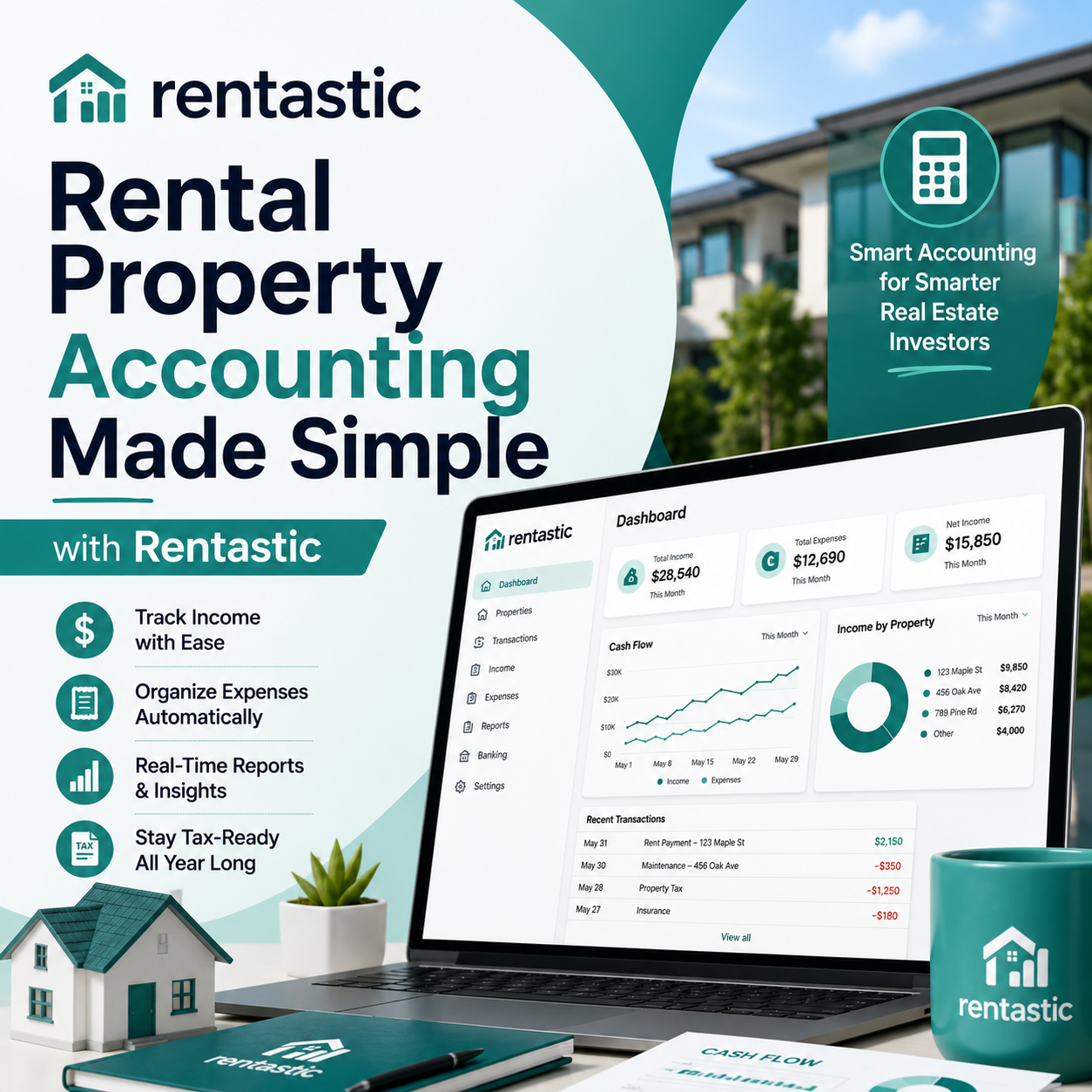
Rentastic’s live dashboards update as transactions post, so you can see cash flow in real time and quickly identify late rent or unexpected expenses (Rentastic). Even if you only reconcile deeply once a month, a quick weekly glance helps you stay ahead of issues.
On the income side, your checklist looks like this:
If you use software that ties tenant profiles to transactions, this step becomes much faster. Rentastic notes that it can flag late or missing payments instantly when bank feeds are connected (Rentastic.io Blog).
Expenses are where many investors lose clarity. To reconcile them:
Automatic expense categorization can minimize the time spent here. Rentastic’s auto-categorization engine applies user-defined rules to about 70 percent of recurring expenses, like utilities and mortgage payments, so you spend more time reviewing and less time typing (Rentastic.io Blog).
You will almost always find small gaps between your books and your bank. Common causes include:
Your job in reconciliation is to:
When you are done, your ledger balance and bank balance should match for that period.
You can run all of this manually, but automation is where you really save time and reduce risk.
Specialized platforms like Rentastic are designed around the realities of rental property bookkeeping. They:
Rentastic notes that users often cut reconciliation time by half and spend around 30 percent less time on accounting tasks overall compared to spreadsheet methods (Rentastic Blog, Rentastic.io Blog). If you value your time at even a modest rate, that adds up quickly.
Rentastic estimates that some investors save over $1,000 per month in labor costs at a $50 hourly rate, simply by streamlining common bookkeeping tasks (Rentastic Blog, Rentastic.io Blog).
When your software and bank talk to each other continuously, you can:
Rentastic’s live dashboards update immediately as transactions post, and its real-time income and expense tracking flags late or missing payments before they snowball into bigger problems (Rentastic, Rentastic.io Blog).
That is a very different feeling from logging into your bank once a month and hoping for the best.
Tax time is where disciplined reconciliation really shines. With automated tracking and clean categories you can:
Rentastic highlights that automatic expense categorization ensures deductible items are tracked accurately and simplifies tax preparation for real estate investors (Rentastic).
If you hire a CPA or bookkeeper, clean reconciled books can also mean lower professional fees, since they spend less time cleaning up and more time advising you.
Bank reconciliation is not just about cleaning up history. It is also about planning your next move.
Once your accounts are reconciled, your reports actually mean something. You can see:
Rentastic’s dashboards consolidate this view so you can compare properties at a glance and drill into the details when you need to (Rentastic Blog).
When you understand your historical spending and income patterns, you can:
Rentastic’s forecasting tools integrate rent estimates based on market data, maintenance costs, taxes, and capital projects into a single timeline to help you manage property financials more proactively (Rentastic).
That kind of forward view is what separates reactive landlords from deliberate real estate investing operators.
Once you have a working reconciliation habit, you can start tracking a handful of simple metrics that tell you if your system is healthy.
From your reconciled records, track:
If your collection rate is high but your speed is slipping, you might need to:
Rentastic notes that landlords who use integrated online tenant payments see fewer late payments overall, which improves cash flow reliability (Rentastic.io Blog).
With accurate categories, you can measure:
This helps you see if:
Clean reconciliation lets you see:
That clarity helps you decide whether to:
These are the decisions that drive your long-term results in real estate investing. They depend on trustworthy numbers.
You can make formal reconciliation smoother by baking a few light habits into your daily or weekly routine.
Instead of saving receipts in your glove box, try:
Rentastic offers mobile expense tracking for Android and iOS, so you can log deductible costs like mileage, repairs, and insurance in the moment and keep tax records accurate (Rentastic Blog).
Those small micro-habits mean you have fewer mysteries to sort out when you reconcile.
Mixing personal and rental expenses in one account makes reconciliation painful. It also muddies your tax picture.
You can simplify your life by:
When every transaction is clearly business-related, reconciliation is mostly matching and confirming, not detective work.
Pick a simple, consistent chart of accounts and stick to it. For example:
Most accounting tools provide a default chart you can adapt for your rentals. Over time, this consistency means cleaner reports and easier comparisons across years and properties.
You can run your own reconciliation for a while. As your portfolio grows, it may be smarter to bring in help.
Consider handing off at least part of the work if:
Rentastic positions itself as a single platform for landlords, property managers, investors, and bookkeepers, which makes it easier to collaborate with a professional when you are ready (Rentastic.io Blog).
If you decide to hire a bookkeeper:
Your role shifts from “doing” the reconciliation to “reading and acting on” the results. That is usually a better use of your time if you want to grow your real estate investing portfolio.
Bank reconciliation for rental properties is not glamorous. It is also one of the quiet systems that separates stressed landlords from steady investors.
To put this into practice:
You do not have to overhaul everything overnight. Start by reconciling last month fully. Then keep up with this month as it unfolds. Within a couple of cycles, you will feel the difference in clarity, control, and confidence in your rentals and your overall real estate investing strategy.
RECENT POSTS


© 2025 Rentastic
Rentastic is registered as a trademark. Terms and conditions, features, support, pricing, and service options subject to change without notice.





.png)



























.png)







































Comments