

If you care about real estate investing long term, you cannot afford messy books. Real estate reconciliation is the habit of comparing your bank and credit card statements to your accounting records so you can trust your numbers. When you keep rental income and expenses in sync with the bank, you protect yourself at tax time and make smarter purchase and sale decisions.
For landlords, property managers, and bookkeepers, bank reconciliation is not just an accounting chore. It is the backbone of reliable cash flow reports, tax-ready records, and credible performance metrics across your rental portfolio. With the right workflow and tools, you can turn reconciliation from a monthly headache into a quick, repeatable process.
In this guide, you will see why reconciliation matters so much for real estate investing, how to do it step by step, common mistakes to avoid, and where automation tools like Rentastic can take hours of work off your plate.
If you only look at your property reports and ignore what is actually happening in the bank, you are flying blind. Regular reconciliation closes that gap.
Here is what it does for you.
Your profit and loss statement, cash flow report, and balance sheet are only as accurate as the data behind them. Reconciliation makes sure:
For real estate investors, accurate financial reporting is critical. The team at Rentastic highlights that reconciliation helps ensure your reports reflect reality so you can base decisions on facts, not guesses (Rentastic).
When your books match your bank:
Tax time is stressful when you are not sure whether your income and expenses are complete. Reconciliation helps you:
Efficient bank reconciliation lets you identify deductible rental property expenses with more precision, which can optimize tax planning and potentially reduce your tax bill (Rentastic).
Tools like Rentastic take this further by keeping profit and loss statements, balance sheets, and expense summaries ready to export, along with automated receipt and mileage logging. That way, when your CPA asks for documentation, you are not digging through emails and shoeboxes (Rentastic.io).
Money leaks are a quiet risk in real estate investing. A double charge, a misapplied payment, or a fraudulent transaction can sit unnoticed for months if you never compare your records to the bank.
Regular reconciliation helps you:
Rentastic notes that consistent reconciliation is a key layer of protection for your rental income and property-related finances because it helps you detect unauthorized transactions early (Rentastic).
In real estate investing, cash flow is your oxygen. An inaccurate view can lead you to:
Reconciliation feeds accurate data into your cash flow reports. According to Rentastic, incorporating regular reconciliation into your overall financial strategy leads to better cash flow reporting, smarter expense optimization, and more informed decisions about new investments and budgets (Rentastic).
In plain terms, you always know what you can safely spend and where you should pull back.
You probably already track cap rates, cash-on-cash returns, and loan terms. Reconciliation is the quiet engine behind all those metrics. If you skip it, every “return” number you look at is suspect.
When you analyze a new property, you lean on projections. Once you own it, reconciliation tells you how close real life comes to the pro forma.
When your historic numbers are accurate, you can plug realistic assumptions into that kind of tool and make sharper buy or sell calls.
If you are managing multiple units or doors, gut feeling is not enough. You need a clear picture, property by property.
Rentastic users, for example, rely on real-time dashboards and automated metric calculations to make portfolio decisions 30 percent faster because they can quickly see trends and patterns in their data (Rentastic.io Blog). That kind of speed only works if the underlying transactions are current and reconciled.
With a consistent process in place, you can:
Lenders and equity partners care about clean, consistent numbers. Regular reconciliation means you can:
When your books tie neatly to bank records, you come across as a disciplined operator, not a hobbyist.
If you have never formalized your process, reconciliation may sound abstract. It is not. It is a simple comparison exercise that you repeat on a schedule.
Here is what it usually includes for rental property owners and managers.
For each bank or credit card account you use for your rentals, you:
If you use a tool like Rentastic that connects to your bank accounts via Plaid, the platform can pull transactions in automatically. Rentastic reports that this kind of automation can cut manual data entry by up to 80 percent, which is a huge time saver for real estate investors managing multiple properties (Rentastic.io Blog).
On a transactional level, you focus on three categories.
For each one, you decide whether to:
The goal is to reach a point where your adjusted book balance equals your adjusted bank balance for that period.
Lag is normal. For example:
You do not “fix” these if there is nothing wrong. Instead, you:
You are looking for errors, fraud, and missing entries, not for normal timing gaps.
You can reconcile on paper, in spreadsheets, or in accounting software. The shape of the workflow is the same.
Decide how often you will reconcile:
A predictable cadence keeps the work small and problems fresh. It also aligns with your broader real estate investing rhythm, like monthly owner reports or partner updates.
For each account you plan to reconcile, grab:
With Rentastic, you can import up to 24 months of past transactions and connect to thousands of U.S. financial institutions, which makes onboarding smooth if you are moving from spreadsheets (Rentastic Blog).
Start on the income side. Go line by line through your bank deposits.
Automation can do a lot of this matching for you. By linking bank accounts, Rentastic automates transaction categorization and can eliminate up to 70 percent of manual tagging, which is a big time saver for rental property investors and managers (Rentastic Blog).
Next, turn to the expense side.
Rentastic’s automated rules engine applies consistent expense categorization for you, reducing manual tagging work by up to 70 percent for real estate investors (Rentastic.io Blog). That consistency makes reconciliation faster because you do not have to decipher vague category names every month.
Do not forget small items like:
These often show up only on your bank statement. Make sure they are added to your books with the right category.
If something does not match, you have three main options.
Your objective is to finish with a reconciliation where:
Once you are reconciled:
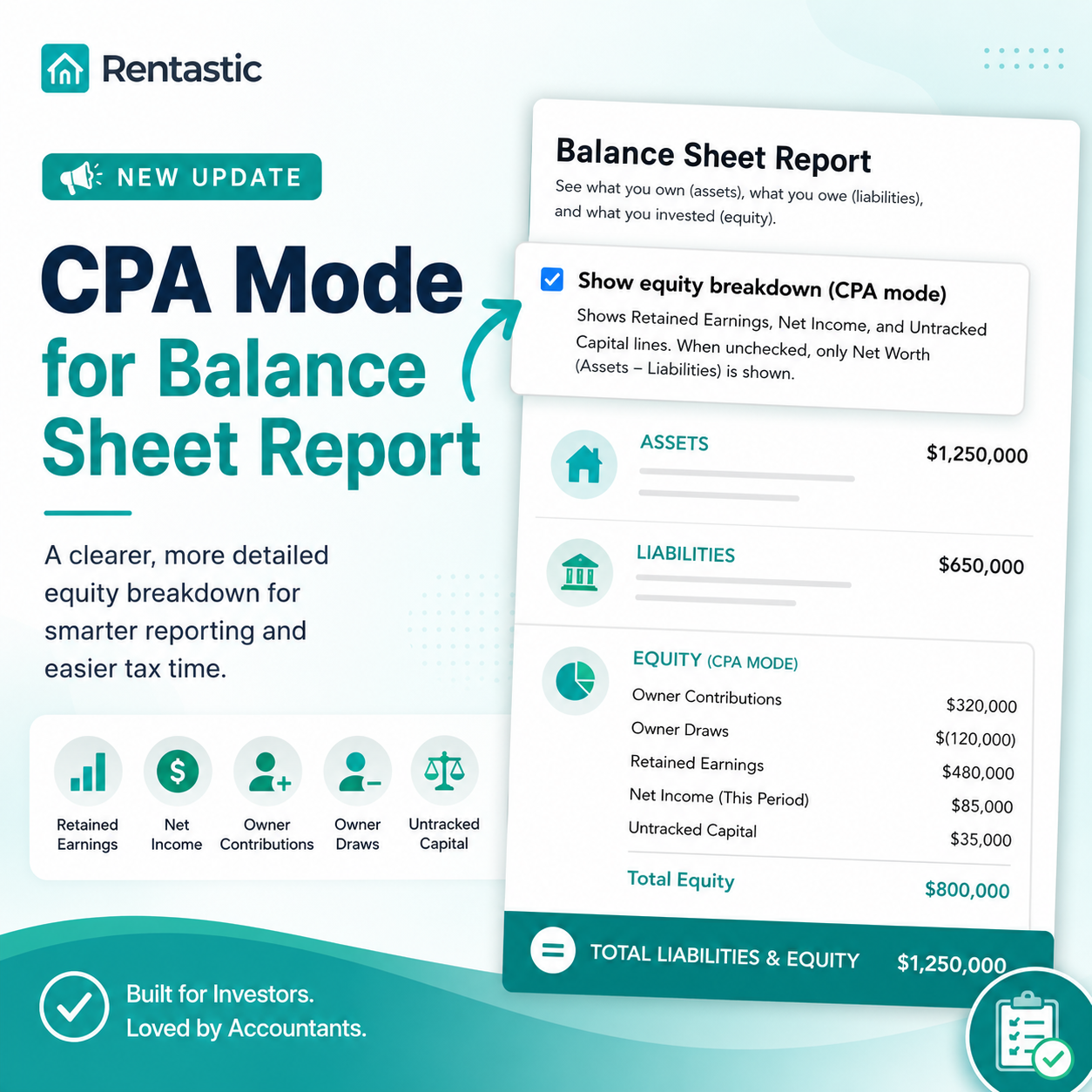
Tools like Rentastic let you generate profit and loss statements and detailed cash flow reports with a single click. That gives you instant, customizable financial insights across your rental portfolio as of 2025 (Rentastic Blog).
You do not need to be an accountant to reconcile well, but you do want to dodge a few classic traps.
Spreadsheets are flexible, but they do not scale well for real estate investing.
If you stick with manual spreadsheets, you are more likely to:
Rentastic reports that investors who switch from spreadsheets can reduce manual entry in rental property bookkeeping by up to 40 percent and cut reconciliation time by 50 percent (Rentastic Blog). When your time is valuable, that is hard to ignore.
If you run personal and rental charges through the same bank account or card, reconciliation becomes chaos.
You can still reconcile, but it will take far longer and you will have a harder time:
A clean separation of accounts keeps reconciliation simple and your financial picture clear.
It is tempting to wave off a small mismatch as “close enough.” That habit is expensive over time.
Small discrepancies often point to:
If the numbers do not tie, find out why. You will either fix a problem or gain confidence that your system is working.
Waiting until tax time to reconcile means:
Monthly reconciliation keeps the workload small and the insights fresh.
You can handle all of this by hand. The question is whether you should.
As your portfolio grows, hands-on reconciliation at the transaction level eats into the very time you want to spend finding deals, improving units, or raising capital.
This is where automation tools like Rentastic make a real difference.
Rentastic links your bank accounts and credit cards through Plaid so income and expenses import automatically. The company notes that this can reduce manual data entry by up to 80 percent for real estate investors who manage rental income and expenses (Rentastic.io Blog).
Onboarding is also streamlined. You can import up to 24 months of past rental transactions and connect to thousands of U.S. financial institutions, which lets you migrate from spreadsheets quickly while maintaining accurate, up-to-date records (Rentastic Blog).
Once transactions reach the platform, Rentastic’s automated rules engine applies consistent categorization. That:
By linking bank accounts, Rentastic reports that you can eliminate up to 70 percent of manual tagging, which shrinks bookkeeping time from hours to minutes for investors and managers (Rentastic Blog).
When reconciliation and categorization are streamlined, your reports are just a click away.
Rentastic provides:
Instead of waiting for a quarterly bookkeeping catch-up, you can decide on refinancing, rent increases, or new acquisitions with current data.
Reconciliation is not just about past transactions. It also ties into how you collect rent today.
Rentastic’s integrated online payment system decreased late rent payments by 25 percent among landlords, which:
Because income and expenses are captured in real time, reconciliation becomes less about data entry and more about quick review.
When your books are tidy all year, tax season is far less painful.
Rentastic helps you:
One verified real estate sector reviewer shared that Rentastic’s automation features eliminated manual bookkeeping mistakes and cut bookkeeping time by over 60 percent, which is a strong signal that automation can reclaim a lot of your calendar (Rentastic.io).
Time is not free. If you value your hours at even a modest rate, the cost of manual reconciliation adds up quickly.
Rentastic reports that real estate investors who switch from spreadsheets can save over 1,000 dollars per month in labor if their time is valued at 50 dollars per hour, simply by cutting the hours spent on bookkeeping and reconciliation (Rentastic Blog).
On top of that, a recent user survey showed that 79 percent of property investors rated Rentastic 5 out of 5 for ease of use and value for money, giving it an overall score of 4.8 from 14 reviewers as of 2025 (Rentastic.io).
You do not need to overhaul everything at once. Start small and make reconciliation a normal part of how you run your properties.
Pick a date that fits your schedule:
Over time, as you adopt more automation, that block will shrink.
Create a basic chart of accounts that covers:
Stick to the same categories every month. If you use a tool like Rentastic, set up rules so transactions are automatically slotted into the right buckets.
Also, commit to keeping rental activity in designated accounts. The cleaner your account structure, the faster and more accurate reconciliation becomes.
Reconciliation is not just bookkeeping. It is a natural trigger to review performance.
After you reconcile each month:
Because Rentastic lets you generate these reports with a click, you can pair reconciliation with a short portfolio health check without adding much time (Rentastic.io Blog).
As your portfolio grows, you can gradually layer in more automation.
You might:
Each step will make reconciliation quicker and your real estate investing decisions more data driven.
Real estate reconciliation is not optional if you want to grow and protect your portfolio. When you reconcile regularly, you:
You can keep doing this work manually or you can let automation carry most of the load. Platforms like Rentastic link directly to your bank accounts, automate categorization, and generate instant profit and loss and cash flow reports, which reduces manual entry by up to 40 percent, cuts reconciliation time by 50 percent, and can reclaim more than 1,000 dollars in effective labor costs each month for some investors (Rentastic Blog).
You are already putting capital and effort into real estate investing. A simple, consistent reconciliation habit, powered by the right tools, makes sure every decision you make rests on solid ground.
RECENT POSTS


© 2025 Rentastic
Rentastic is registered as a trademark. Terms and conditions, features, support, pricing, and service options subject to change without notice.





.png)
























.png)




































Comments